> For the complete documentation index, see [llms.txt](https://takeform.gitbook.io/docs/llms.txt). Markdown versions of documentation pages are available by appending `.md` to page URLs; this page is available as [Markdown](https://takeform.gitbook.io/docs/integration/auto-fill-pdf-from-an-email-using-zapier-+-takeform.md).
# Auto-Fill PDF from an Email — Using Zapier + TakeForm
In this tutorial, you’ll learn how to automatically fill a pdf form by using data from body of email — all powered by **Zapier** and **TakeForm**.
## Step 1: Upload your Form to TakeForm
> *Skip this step if you’ve already uploaded your form.*
Follow guide [Upload your PDF Form](/docs/upload-your-pdf-form.md) to upload your form and get `form_id` , you will need it to setup Zapier Action. In this tutorial, I will fill w-9 form of US. The id is `ff6957fb-9401-429d-9c86-f524000e4394`
Form Id in Header
## Step 2: Get a TakeForm Api Key
> *Skip this step if you’ve already uploaded your key*
Follow guide [API Key](/docs/api-developer/api-key.md) to get an Api Key. You will need it to authenticate with TakeForm from Zapier. In this tutorial, the API key is `0d45d24d-a9d4-446f-b17a-e7529e5ca59e` (don't worry, I removed it in my account).
## Step 3: Create Zap and add Email Trigger
> You can use other trigger like Google Form, Gmail, Outlook, etc. TakeForm AI can understand all their contents.
1. Create Zap in
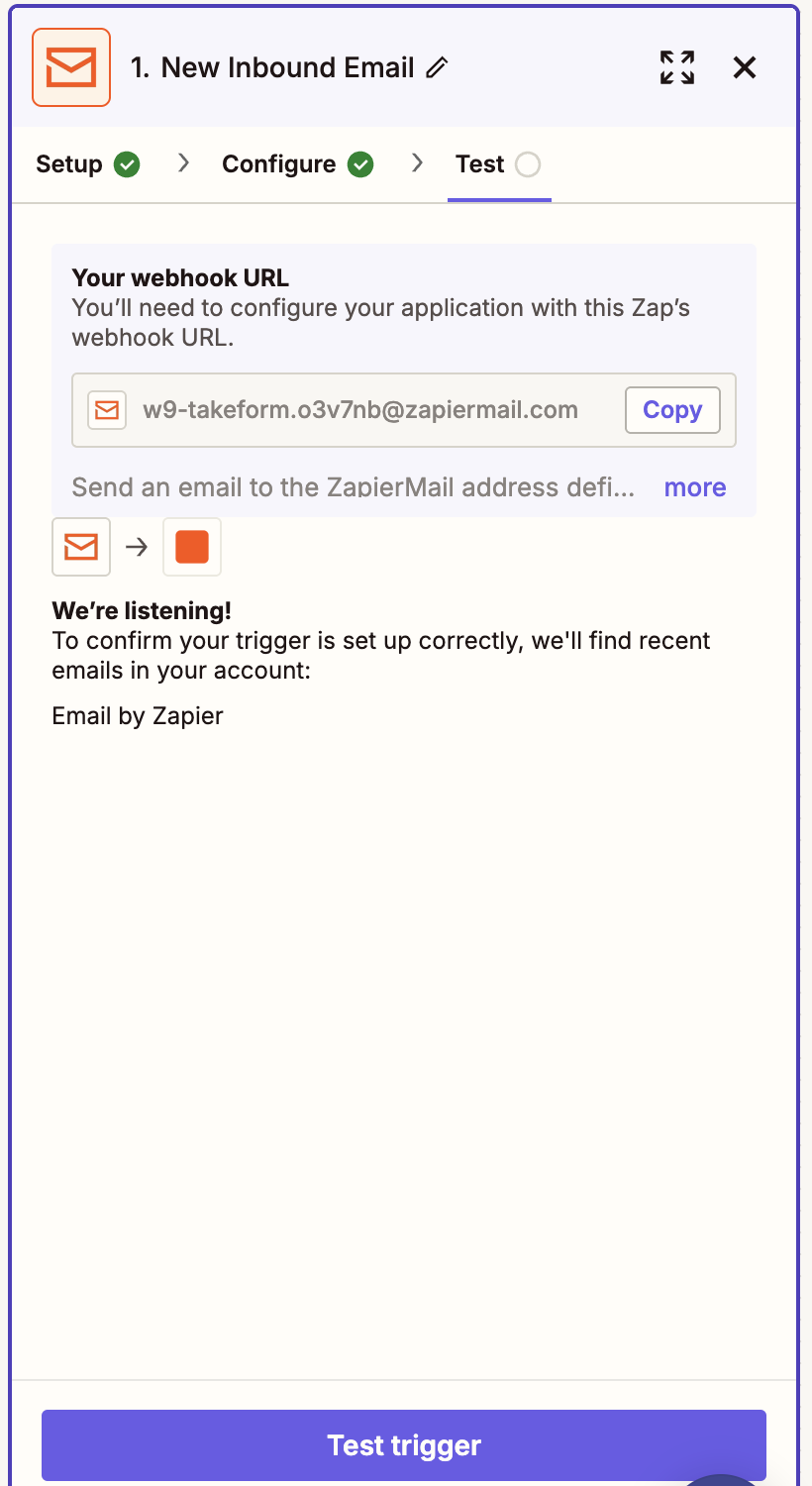
2. Add a Zapier Email Trigger (or another email platform that you want to use)
3. Set `Trigger event` is **New inbound email.** It means this Zapier app will be triggered by new email.
4. Set `Email Address` for the Email Trigger. I use `w9-takeform` .
5. Test trigger by send and sample mail to the `Email Trigger` then click next to move to next step.
## Step 4: Add TakeForm (1.0.0) Fill Form Action.
1. Click add Action in Zap.
2. Type "TakeForm" and choose **TakeForm (1.0.0) integration.**
3. Set `Action Event` is **Fill PDF Form**
4. Click `Account`Zapier will pop up a window. You need to enter your API key (in [#step-2-get-a-takeform-api-key](#step-2-get-a-takeform-api-key "mention")) into the box and run authentication.
5. Set the `Form ID` to the form you uploaded (in [#step-1-upload-your-form-to-takeform](#step-1-upload-your-form-to-takeform "mention")). For me, it's w-9 form with id `ff6957fb-9401-429d-9c86-f524000e4394`
6. Set `Dynamic Data` is Stripped Text of Email Trigger.
7. Click **Continue**. Done! You've completed the Zap. Now it's time for testing.
***
## Testing new Zap
I will send an email to email trigger (`w9-takeform.o3v7nb@zapiermail.com`) with content
```
Hi Team,
Please find below the required details to complete the W-9 form for our vendor setup:
- Name: John A. Smith
- Business Name: Smith Consulting LLC
- Federal Tax Classification: Limited Liability Company (LLC)
- Tax Classification Type: C Corporation
- Address: 123 Business Rd, Suite 456, San Francisco, CA 94107
- Social Security Number (SSN):
- Employer Identification Number (EIN): 12-3456789
- Signature Name: John A. Smith
- Date: April 17, 2025
Let me know if you need anything else.
Best,
John
```
This is the result
{% file src="/files/nbI8VCB0brvF2R0vLVNH" %}
***
## Video Demo
{% embed url="" %}
Zapier x TakeForm
{% endembed %}